Showing posts with label Guide to Investing. Show all posts

Why We Need to be More Cautious

It was yet again another strong week for Philippine stocks market. The benchmark index rose 30.56 points to 5,794.20, slightly below the 5,800 mark. Recent favorable economic data continue to propel local bourse into new heights despite high market valuations. IT was reported last week that the Philippine economy posted a surprising 7.1% growth in GDP.

A Questionable Run? 

PSEi continue to reach new highs, but the number of declining stocks mostly outnumber or equal the number of rising stocks. Below table is the stocks movement from November.    


Notice that when PSEi declines, stocks advancers always outnumbered the decliners, except on November 14. But when PSEi is up, the overall market does not necessarily follow the trend. Out of 18 times the benchmark index has moved up, there were only 10 times that the advancers outnumbered the decliners. 

What this means is the overall market is not really having a bullish run. Some stocks, notably blue chip companies, just outperform other stocks. In can also be a rotational play on traders where a stock that previous fell would catch the attention as being "cheap" and would therefore rise the following day. 

Last week, I encouraged everyone to take action and start investing. But we also have to be mindful of what we invest in. Even though the stocks market reaches new high almost everyday, it does not mean you can buy any stock there is and expect a profit. That's not how it works. You still have to put on the hard work and do researches in order to achieve your desired results. If you are already investing, it may even be not a bad idea to start asking yourself, "When can I sell and take my profits?"


Recommended:
Moderate Your Greed
Bulls and Bears
Trading vs Investing

When are you gonna start investing in your country?

The Philippine Economy has never been this better. The country posted third quarter GDP with a surprising 7.1% increase, beating almost every financial institutions' forecasts. GDP or gross domestic product is the market value of goods and services produced within a country in a given period. It accounts the country's private consumption, gross investments, government spending and export-import transactions. After the release of the favorable growth, most analysts now believe continue to sustain the momentum and post 6-7% overall growth for the year. 
source: interaksyon.com
The stocks market have posted its 32nd record high. The Philippine peso is expected to remain stronger and hit P37:$1 by 2013. Investor confidence is at the highest. It's clear that the Philippines is on the rise. So the question is: When are you gonna start investing in your country? Yes, there is no guarantee that it will continue to remain strong in ten, or even five years; and yes, there are still people losing money despite of the good economy. But if you don't start now, then when? If you can't will yourself to even try then you will forever be afraid of taking that first step, no matter the economic condition. They say "you must do something you haven't done to achieve something you haven't achieved", and the time to take action is now.  


Recommended:
Moderate Your Greed
Investing Lessons Learned the Hard Way
Stocks Profit Calculator

Moderate Your Greed


The recent stories of around 15,000 Filipinos who have fallen victims of pyramid scam is both disappointing and also alarming. 

The tactic used was simple. Aman Futures Group made claims of trading commodity futures and promised high returns for those willing to shell out money. The victims ranged from motorcycle drivers to vendors, businessmen to teachers. People from all walks of life were seemingly enticed by the prospect of earning easy money without doing anything. All they had to do is withdraw their funds and trust the testimonials of a family, friend or neighbor who were reaping wonderful profits in their investments. When you could see that they have managed to renovate their old huts with two-storey concrete houses why not right? The proof of wealth is glaringly visible in front their eyes. 

Perhaps the most alarming thing is even if some people knew this was in all possibilities a scam, they still chose to gamble their money to take a hitch on the ride. Most of them planned to take their investments out once they've earned enough. But people are naturally greedy by nature having enough money is always never enough. Unfortunately for those people, they were also on the ride when everything fell apart.

I can only hope people take it as a warning. With all the networking schemes sprouting everywhere which hides itself into offering beauty and enhancement products, I am all too certain that one or two of them is downright scam.

Learn what you are getting into, specially when it involves taking out money. We can't stress enough the importance of doing your own research and not just solely relying on someone else's words. While it is disheartening specially for our fellow citizens to lose all their wealth for something so meaningless, they were blinded by greed and lured by earning easy profits. Let their stories serve as a lesson for us to moderate our greed. As a general rule, if what they're offering is too good to be true, it probably is. Learn to politely decline and shrug it off, then turn the other way and never look back.


Recommended:

Stocks Investing Lessons Learned the Hard Way


I started investing September last year. But even before I decided to start, I have read a lot of books on investing. I would scour for books in National Book Store or download company materials from the PSE website to learn more of investing strategies and of course, the companies I wanted to invest in.

The tension in Greece and the global financial crisis was on top of everyone's mind that time. By October and November, all the stocks were down. There were even fears that there was a bearish sentiment. I had to endure around 10% loss on my portfolio. The good thing was I still have emergency cash to add to my investments. It helped because I could buy more stocks, only much cheaper this time. I used the additional funds mostly buying more stocks from the ones I already held. In Ctisec/COL financial terms, I simple used peso-cost averaging. 

Two particular stocks caught my attention - EEI and PGOLD. EEI Construction was priced at around 3.30. It was November, and the government has not yet laid out a clear plan on its Public-Private-Partnership, a move seen by many to largely benefit construction companies. Looking at EEI's financials, their numbers looked solid. Their revenues were coming from different projects with clients including SM, DMCI, Ayala, RCBC, Globe - almost all of the big names which are currently constructing large buildings and new offices. You only have to go in Bonifacio Global City and check out how many ongoing constructions are being done by EEI simultaneuously. My gut tells me the stock will soon double. I decided against it. Now the stocks is priced somewhere at P8.80. I was still lucky I caught it around P6.50.

Puregold, on the other hand, was not getting the attention it deserved. The company which was touted to directly compete with SM's Hypermarket were being snubbed early on. After its initial public offering at P12, it fell somewhere at P11.40 in days. A bailout plan was released for Greece, and the stocks market was alive again. I bought PGOLD when it went back to P12. I sold it weeks later at P15, only to buy it back again at P18. I eventually sold it again when it reached P24. Now the stock is trading at around P29-P30. I plan to buy again when it pulls back to P26-P27 range.

There were three main lessons I learned from these events. 

One, always have an emergency fund. The market may be well and good today, but you will never know when the next bearish market comes. For those who are new in stocks market, this is perhaps the most important advice you should take. You may not think that the stocks market will eventually have its down period, but believe me it will happen. Nobody knows when exactly, so the best way is to allot some money that can help augment your investments when the market is down.

Two, Learn to trust the numbers. I've spent countless nights looking at company financials analyzing which for me was the best investment. EEI was right in front of me and I let it slip by! When you invest in stocks, do not look which companies are popular because more often than not, they are already well invested in. Look for the ones with strong fundamentals and the stocks price will soon go up.

Three, as the old adage goes, patience is a virtue. Imagine if I only held on to my PGOLD stocks when I first bought it at P12. My profit wold have been almost three times! Also, trading costs no matter how small it is, still reduces your profit. The reason why I still plan to buy PGOLD is I believe it hasn't yet reached its peak, and this time I plan to hold it until their performance slows down.

I could give more lessons I have learned this past year, but none sticks with me more than these three. I could have posted larger profits if only I knew all of this, but I got something far more valuable than large gains - I learned.


Recommended:
                 

Stocks Profit Calculator

We all know that buying or selling stocks do not come free. To maximize our profit, we should take into account brokerage charges and other handling fees associated in every transaction. The following is the list of the corresponding charges executed every time we trade stocks:

Broker commission. These are the fixed fees your broker charges you. Online broker accounts typically range between .25% to .50%, depending on what online account you maintain. Some brokers also charge minimum fees per transaction. For COL financial, for example, they charge P20 broker commission or .25% of the total amount, whichever is higher

Value Added Tax. Computed as 12% of broker commission amount.

PSE Fee. This is a fixed transaction fee imposed by PSE at .005% of gross amount.

SCCP Fee. Securities Clearing Corporation of the Philippines handles the clearing of the transactions and processing of certificates. SCCP charges a fixed fee of .01%

Selling Tax. Computed as .5% of gross amount. This fee is only applicable on when you are selling your stocks.

If we are not careful, we might end up losing money without even knowing it because we failed to compute for these charges. Seasoned investors use spreadsheet calculations to easily help them determine their potential profit or loss. 

We recognize that most individual investors do not have the skill or time to make their own profit calculator. The good news is you don't have to because we have created one for you!


You have to determine first how much your broker charges you per transaction and if they impose a minimum broker fee to use this file effectively. All you have to do after that is input how many shares you buy, on what price you bought it, and on what price you expect to sell it. The net profit turns green when you incur gains and turns red if a loss is expected.

All you have to do is subscribe to us via email to download the file!
(You can also use the subscribe button on the right if the link is not working)  

Hopefully this enables you to focus more on analyzing your investments rather than tediously computing for these fixed fees. More time means more learning, and more learning means more profits. Happy investing everyone!

Online Brokers and How to Open an Online Account

Since we started, we have been receiving a lot of queries on how to start investing. First, you have to arm yourself with considerable knowledge before venturing any capital on investing. Learning is a continuous process even for people with long years of experience in the stocks market. Even highly educated people find time to update themselves and sometimes re-learn what they know. The second, and perhaps more concrete step in starting to invest is finding a stockbroker. The easiest and most accessible these days is through online. Below are the list of accredited brokers by PSE: 


We will provide a comprehensive review and comparison of strengths for each of these online platforms in our subsequent posts. For now, we will focus on how to open an account.

Generally, there are five steps in opening an individual online account:

1. Download the online application form. These are usually found in the home pages of the stockbroker's site.
2. Fill up all the necessary details in the form.
3. Send out the form to the office address indicated in the form along with your valid ID with picture. Some online brokers allow online submissions as long as the form is clearly filled-up. Also, others may have particular preference or may require two or more on the IDs to be submitted. Generally, all government issued IDs or passport are acceptable.
4. Wait for a few days until your account is approved and activated..
5. Fund your account. The initial amount varies among the brokers, but regular accounts usually require P25,000 balance.

For joint accounts, both account holders are required to provide the requested documents. For corporations, additional documents will be needed:
          a. SEC Registration Documents
          b. Latest Articles of Incorporation and By-Laws
       c. Board Resolutions/Secretary Certificate ( approval to open an online trading account with AB Capital Securities, Inc. and the authorized officers with specimen signatures beside their names)
          d. Latest Audited Financial Statements
          e. Company Profile
          f.  Latest General Information Sheet (Ex: List of Directors, Partners, etc.)
          g. List of Principal stockholders owning 2% of the Capital Stock
          h. Principal IDs of authorized officers (Ex: Passport, Driver's License, etc.)


The money you will deposit will be used so you can start buying stocks. If you are not sure or not confident with your judgement, transactions can also be broker-assisted - meaning a stock agent will help you decide on what is best to buy based on your preferences and risk tolerance, for higher commission fees. I have never tried broker assisted-transactions, but I think it can be helpful for beginners. As our wise elders would say, admitting you need help is the first step to get help. You wouldn't want to lose your investments by trying to do it by yourself even if you are not yet capable of making a sound judgement. Also remember that opening an account is just the beginning, earnings profits are achieved through learning, hardwork and experience.   


Recommended:

Blue Chips and Penny Stocks


If you follow the stocks market closely, you surely have heard the term blue chip or penny stocks from analysts and forecasters. Blue chip refers to stocks in a corporation with a high reputation of quality and has the ability to operate with profits through good times or bad. The term is derived from the game of poker, where blue chips are regarded as the highest value chip. The most popular index that follows blue chip stocks are the US' Dow Jones Industrial Average (DJIA) which contains only the leading 30 stocks from different industries.

On the other hand, penny stocks are shares of public companies that trade at low prices per share. Due to its cheap price, most penny stocks have low market capitalization which makes it highly volatile. It presents higher risk for investors who are enticed by the hope of making large and quick profits. Most cases of price manipulation use penny stocks because it is cheaper to purchase large quantities and can be easier to inflate the prices artificially.

To show an example of how the risks differ, let us take a look at Aboitiz Equity Ventures (PSE:AEV) and Manila Mining Corporation (PSE:MA). The graph below shows how the two stocks traded between Oct.15 - 19, 2012. 


MA traded from P.0500 Oct 15 to P.05700 Oct 19, increasing by .07 or 14% in just one week. In contrast, AEV increased by P.60 from P48.3 Oct 15 to 48.9 Oct 19, but was only up 1.24% for the week. Why is it that a penny stock like MA is more volatile than a blue chip stock such as AEV? The reason lies on its stocks price. The higher the value of the stock, the lesser the chances that it will materially fluctuate making it more steady and stable. When the stocks prices are cheap, any small movement on its value is still significantly large as a whole. 

In the Philippines, the list of the PSEi benchmark index are considered the blue chip stocks. These stocks are usually in the portfolios of "safe" investors, as these companies have strong balance sheet and earnings statements. Meanwhile, penny stocks are usually the mining and oil companies when it is still on its exploration stage. The risks on investing for these stocks are higher, but the rewards can also be huge. Again, our tolerance for risk will be important in deciding what type of stocks we choose to hold.


Recommended:
What You Need to Know About Dividend Dates
Dividends As Investment
Passive Income Explained

What You Need to Know About Dividend Dates


Last week we have discussed about dividends and why investors are inclined to use it to increase their returns. Today I want to tell you more on the important dividend dates and what it means. We shall use below actual dividend declaration made by Globe Telecom, Inc. (PSE:GLO) last August 6, 2012.

Declaration Date

Receiving dividend income starts when the company's board of directors have agreed to pay its investors a certain amount per number of shares they hold. Declaration date is the period when the company announces to the investing public to pay out dividends.

Record Date

This is the date when the stockholders of record are entitled to receive dividends. In the above example, The record date is set on August 28, 2012. This means that every stockholder who appears in the company records as having owned shares as of August 28 will get dividends. 

Ex-Dividend Date 

For a listed company, buying and selling of shares commonly take place and give rise to an important question - How do we determine who is entitled to dividend? In the Philippines, it usually takes three business days for a transfer of ownership to be cleared and appear in the company records. Ex-dividend date is one day prior to the date that a person must own a share of stock for it to appear on the records and be entitled to dividend. In our GLO example, August 28 falls on a Tuesday. Since August 27 is a declared Philippine Holiday, the ex-date would be on August 22 (the three day clearing period being Aug. 22, 23 and 24). This means that you must have bought GLO shares before August 22 to be entitled to dividends.

Payment Date

This is the date when the stockholders will receive the dividend.


Companies know the importance of declaring dividends specially for listed entities because it helps them attract more investors and reflects good standing. But it also doesn't mean that companies that do not pay off investors through dividends should not be invested in. It may be that the management chose to reinvest the income they earned to use for expansion, debt reduction or other business activities. Bill Gates' Microsoft, for example, did not pay dividend until it had become a $350 billion company. It is up to us investors to know which ones we prefer and take that as a guide on how we use our investment money.  


Recommended:

Dividends as Investment

Most investors rely on stocks price appreciation to grow their investments. For example, you decide to spend your P 10,000 to buy 100 shares of Jollibee (PSE:JFC) at P100 per share. After two months, news came out that JFC opened up a new branch in China, making investors project that there will be increased earnings. As a result the stock price appreciate to P110. Your gain from your investment at this point is P1,000. (P10 price increase x 100 shares).     

This investment approach works fine if the stocks continue to appreciate. But people familiar with the stocks market know it is not always the case. The price of stocks fluctuate everyday, and the gain you earned the previous day can be gone by the following day. From our example, let's assume that the new China branch did not attract a lot of customers and JFC did not meet its income target after six months. As a result, the stocks price dropped to P90, which is ten P10 lower than you bought the stocks. As a result you lose P10 from your investment. (P10 price decrease x 100 shares).

*The effect of taxes, commission ad other transaction costs were excluded to simplify

Even if the price increased in two months, it can also be reversed due to price fluctuation. You may have heard of the term "paper income". This simply refers to your potential gains or losses if you decide to sell your investment at current market price. If you have sold your investment after two months when the price was at P110, you would have locked-in on your gain of P1,000.

Dividends - A lock-in of investment returns

That is mainly the reason why some investors are attracted to dividends. Dividends are payments made by the corporation to its investors using a portion of its income. In other words, it is the investor's share of profits from the company. It gives them a substantial return on their investment that is realized once the payment period takes place. 

Dividends are normally paid in cash, but it can also be in a form of property, scrip, or even additional shares of stock. Although PSE does not require dividend issuance, most big companies such as JFC, SM, BDO and PLDT declare dividends on a regular basis. You can see sample dividend declarations here and here. For investors, it is a safe indicator that the company remains stable if it can pay-out dividends continuously. It also satisfies the investor's main goal of getting a return on their investment, and make them feel at ease of holding on the stocks even if there are fluctuations in price.


You might also like:

Guide to Philippine Stocks Market: Official Logo

It's been four months since I started to work on this site to bring more awareness and help people succeed on investing in the stocks market. The site has generated quite a number of followings and I couldn't be more proud! In celebration of all the support and love people have shown, I officially unveil our new logo. It's a pretty neat upgrade from the text-only header we previously had, plus it looks stylish and totally blend on the layout. 


Allow me to share some more background on its details and what it all means:

The green font color symbolizes stocks market increases. It's no question I wanted it  dominantly seen as I envision to have a good return on my investments. The red font color is for stocks market declines. Although nobody wants to incur losses, we all need to be reminded to act with caution and think our decisions through. The rectangular box on the letter "G" encourage us to think outside the box and to stop being so narrow minded. The glowing yellow borderline are like our thinking light bulb that help us make wise investment decisions. The extended arrow leading to the stocks chart serve as our road map to attaining financial success. And finally, the tagline "A daily Guide to financial wealth through stocks" highlight our commitment to bring the latest stocks news, market updates, trading alerts and financial insights to everyone. 

I hope you liked our logo and be sure to visit us everyday! Happy investing!

Passive Income Explained


Passive income.are earnings derived with little or no effort required to maintain it. It usually comes in two sources: Rental activity and trade or business activities in which no material participation is required. If the paychecks you receive from your employers are your active income, then your passive income are the earnings from your rental property, royalties from books, dividends and interest income from securities, and earnings from internet activities, to name a few. In simple terms, passive income is making your money work hard for you.


Generating income is a continuous learning process, and it is true even for passive earnings. It took me two years of planning and looking around for the best prices before I bought my first investment property. Why did it take me so long? Because I wanted to find an ideal place that I believe will offer best returns when the time comes that I can lease it. I won't be able to generate any earnings from it until 2014 as it is still on a pre-selling stage, but I'm confident that the decision to buy it will pay off. 

Investors understand the value of patience when they are dealing with passive income. There are no shortcuts, lest you'd be short-cut, that is cut short from the potential earnings you might have had if you only waited out. It is called passive income for a reason - because you don't have a direct control of where your investments will lead you. Unlike in owning a business, you can actually think of something to drive sales up or serve your customers better. Time is your best ally in passive income because you often have to wait before you make significant returns. 

Having passive investments doesn't mean you don't have to take active involvement. I make sure I regularly check on my stocks investments at least twice a week. This enables me to make timely decisions should there be significant developments that may affect my portfolio. For example. I was able to sell off the EDC shares I hold right after the news of a another delay on their income-generating plant came out. I'm not saying I have made the correct decision. For all I know EDC may still post good income figures, but in keeping myself updated I can shift my investment to a new stock where I feel more comfortable. I don't have to wait anxiously and worry if the  portfolio I hold will generate good results. I can sleep sound at night because of my stress-free investments!

In the next posts I will discuss how I was able to grow my passive income, and how you can have yours too. Have a nice weekend!


You might also like:
Choosing the Right Investments
How to Read Stocks Quotes
How the Stock Market Works
    

How the Stock Market Works - Financial Institutions


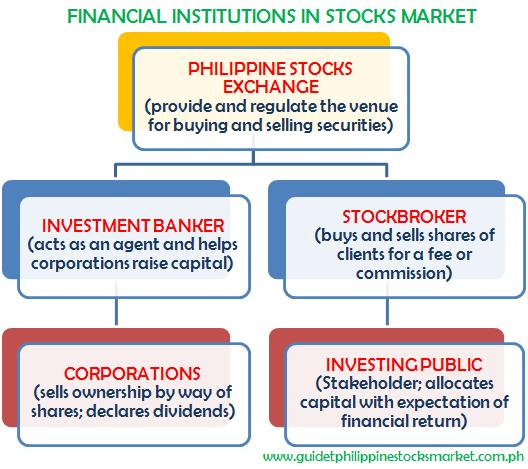
Last week we discussed how the stock market works and the roles of different financial institutions involved. For today, I want to show you how these institutions are connected and how it functions:


Corporations are the business that need to raise funds by making portions of their equity or debt securities available the investment public to buy.


The investment banker assists corporations, government or institutions in raising capital by underwriting or the client's agent in the issuance of securities.


The Philippine Stocks Exchange facilitates the trade and is primarily responsible for bringing all parties together. 

The investing public allocates their capital expecting a financial return in the future. It can either be in a form of stocks appreciation, dividends, stock options and rights, warrants and other similar vehicles that generate profits.  

The stockbroker serves as the middleman in completing the transactions between the investing public and the placements made by the investment banker in the stock exchange. Their income is primarily derived from fees and commissions.

Some of you may wonder why the corporations or investing public do not transact directly with the exchange. The need for "middlemen" such as investment bankers and stockbrokers actually offer these corporations and investors expertise and provide useful information that are otherwise very difficult to obtain. They can give relevant updates from the stocks exchange even before it is released in the media. 

As you know, being always updated with the current news play a significant part of every trader or investor's success. Even a one-day delay can mean a big difference of making a profit or a loss. 

You might also like:
Your Investment Timeline and Why You Should Start Early
Bulls And Bears
Trading vs Investing


How the Stock Market Works


I've been wanting to write a simple step-by-step guide on how the stock market works. While searching for materials to better explain it I stumbled on this comprehensive cartoon video describing every step of the process. I share this video with you and provided a brief outline: 
  • A company needs to raise more funds for various reasons (expansion, to pay off debt, to finance new projects, etc.)
  • The company gets a permit to sell its shares (proof of ownership of the company) 
  • The Company seeks the help of an investment banker and presents essential documents to be used in registration
  • The investment banker provides information on the company to Securities and Exchange Commission and attests the accuracy of the information provided.
  • SEC approves the registration as a listed company
  • The investment banker pays the company in exchange for a certain number of shares.
  • The investment banker sells the shares through the stocks market (or the Philippine stocks exchange locally)


  • The most common way for the public to profit from investing is through price appreciation and dividends (return on a portion of income)
  • A good earnings performance by the company will naturally help the price to increase and  will allow it to declare dividends, thus attracting more investors.
  • The value of the stocks may go up or down because of different perceptions of the investing public (An investor may deem a stock price to be cheap at P100, but another may think that's too expensive)
Should the company need additional funds it can again go through the same cycle by issuing additional shares, subject to approval and complying with necessary requirements. Next week we'll discuss the important roles of each institutions involved so make sure to visit us again! 

Happy investing!


You might also like:

Your Investment Timeline and Why You Should Start Early


I read an article recently on how the life cycle investment timeline of a person usually goes. In summary, there are three stages:

Growth Period (Age 20 - 35) - Stage where we accumulate assets to use as capital for future investments.
Consolidation Period (Age 35 - 55) - Includes paying off debt, shifting on investments that fit our risk appetite, more stable earnings  and retirement plans.
Retirement and Spending Period (Age 55 and up) - All life-time earnings are accumulated and have the ability to spend for the remaining years of your life.

Imagine if you can start your investment timeline much earlier. Perhaps during college or even high school? You can actually open investment accounts today for as low as P 5,000. If you started investing at 16 and assuming your investment grows 5% annually, then you will have P27,580 by the time you're 50. 

Not impressed? Let's assume  you started at 50,000 and this time, your annual return is 10%, which is common for average investors. After 35 years, you'll have P 1.4 million or 28 times more than you first had! 
Of course there are risks of losing money, but if you're truly motivated and willing to learn, your investment can also perform much better in a shorter period!


I started to learn about investing when I was 19, but I have only started actually doing it at 23 when I opened a time deposit account. It takes time, and courage, but everything would be worth it once you realize you'll be much better financially over time. Now I'm 26 and in the accumulation stage. My investment plan is to save and be able to consolidate all my assets by the time I reach 40. If all goes well, I'll be able to retire by then and spend the returns on my investment.        


Contrary to what other people may want you to believe, being rich is not easy. It takes a lot of hard work and effort. All the rich people you've seen or heard of have all devoted time to learn and improve on their craft. 

The good news is there's nobody that can stop you from doing just that.


You might also like:
Choosing the Right Investments
Bulls and Bears
Trading vs. Investing

Bulls and Bears


You often hear the terms bull market and bear market when reading newspapers or attending gatherings about the stock market. What does it mean and why is it being used to refer to market's movement?

According to Investopedia, there is a Bull Market when there is a presence of "optimism, investor confidence, and expectations that strong results will continue." On the other hand, a Bear Market is a condition wherein "prices of securities are falling and widespread pessimism causes the negative sentiment to be self-sustaining". The standard measure uses 20% of advance or decline rally. In simple terms, there is a Bull or Bear Market when there is an extended period of consistent rise or fall on prices of stocks in the financial market. This should not include short term rallies of less than two months, as this are deemed normal movement in prices. Before you get excited and change your position two thing should be considered: Is it consistent and is it happening on an extended period?

Many analysts say that the Philippines is enjoying a Bull market these past months. 


The graph shows PSEi's share price for the past year. The downward movement around September and October last year was mainly due to the Greek debt crisis which had all indexes around the world negatively affected. Despite some analysts saying that it was a bearish period back then, I personally did not think that was the case as it only lasted a little more than two months and the market was more driven on sentiments and what if scenarios rather than actual data. 

PSEi's performance had much improved since then, thanks to solid economic growth and many companies hitting or surpassing income forecasts. I think it is a legitimate bullish run, but all indications also point that it is nearing its end. September and October are widely considered light trading months, where most market participants take a breather and assess their positions before eventually committing to their chosen stocks to close the year. We will likely see PSEi's performance dip a bit with a sideways movement at best. This opens up a great opportunity to buy as stocks will be on bargain. We just have to keep a watchful eye on news that may drive the market in either directions.

You might also like:
Choosing the Right Investments
How to Read Stock Quotes
Trading vs. Investing

How To Read Stock Quotes


Before online platforms on stocks trading were introduced, clients would place their orders through phone calls. Now, buying and selling stocks are just a few clicks away. Online trading makes it easier for the investing public to change their position at their convenience. Next to opening an account, you need to familiarize yourself on the basics of reading stocks quotes.

Stock quotes show the participants' willingness to buy or sell in a market. Bid and ask are terms usually used and show the price and volume that the public is willing to have. If you are interested on owning a stock, you'll need to place a bid on how much you want to buy it. If you already own a stock and want to sell it, you'll need to place an ask price for how much you want to sell. Every order should have corresponding volumes, the number of shares you are buying/selling. In some trading platforms you can see the number of participants (willing buyers/sellers)  that placed an order at a particular price.

The highest buy price and the lowest sell price would be read as the market's quote. For example, the chart below would be "buying at P 2.13 and selling at P 2.15". 


Once an order is matched it is removed in the board and the transaction is considered settled. You can also opt to wait and place an order below the best bid price or above the ask price. This will not be matched until someone places an order at your desired price.

Another tool on reading market quotes is a ticker. If you have been in Ayala Triangle in Makati between trading hours you will see a ticker tape in Insular building's electronic board. 


A ticker tape is a string of stock information currently being traded real-time. It shows the company and stock symbol, last trade price and volume and percentage of movement for the day. Green indicates that the stocks are up while red tells us the stock is down for the day. Unchanged stocks are usually indicated in blue or yellow.

I admit I did not know any of these when I started investing and I had to learn by myself. These are simple information, but a valuable guide specially for beginners. Well that's about it! I hope you enjoyed today's post. Have fun making money everyone!

PSE Issues New Benchmark for Index


The Philippine Stocks Exchange, Inc. release below list as a benchmark for PSE main index:

1.   Aboitiz Equity Ventures (AEV)
2.   Aboitiz Power Corporation (AP)
3.   Alliance Global Group, Inc. (AGI)
4.   Ayala Corporation (AC)
5.   Ayala Land, Inc. (ALI)
6.   Bank of the Philippine Islands (BPI)
7.   BDO Unibank, Inc. (BDO)
8.   Belle Corporation (BEL)
9.   DMCI Holdings, Inc. (DMC)
10. Energy Development Corporation (EDC)
11. First Gen Corporation (FGEN)
12. Globe Telecom, Inc. (GLO)
13. International Container Terminal Services, Inc. (ICT)
14. JG Summit Holdings, Inc. (JGS)
15. Jollibee Foods Corporation (JFC)
16. Manila Electric Corporation (MER)
17. Manila Water Company, Inc. (MWC)
18. Megaworld Corporation (MEG)
19. Metro Pacific Investments Corporation (MPI)
20. Metropolitan Bank & Trust Company (MBT)
21. Petron Corporation (PCOR)
22. Philex Mining Corporation (PX)
23. Philippine Long Distance Telephone Company (TEL)
24. Robinsons Land Corporation (RLC)
25. San Miguel Corporation (SMC)
26. Semirara Mining Corporation (SCC)
27. SM Development Corporation (SMDC)
28. SM Investments Corporation (SM) 
29. SM Prime Holdings (SMPH)
30. Universal Robina Corporation (URC)

Petron Corporation will replace Cebu Air, Inc. (CEB) in the benchmark effective September 10, 2012.

Join the Discussion